skip to main content
Don't forget to complete your donation
complete your donation
Your saved curriculum
Placeholder profile picture with a blue fish illustration
Curriculum name
SaveRemove
Nothing saved yet — tap the bookmark on any curriculum to keep it here.
← Back to Curriculum
No more grades

The Harbor Ecosystem

Unit
19
Class Periods
0
Field Visits

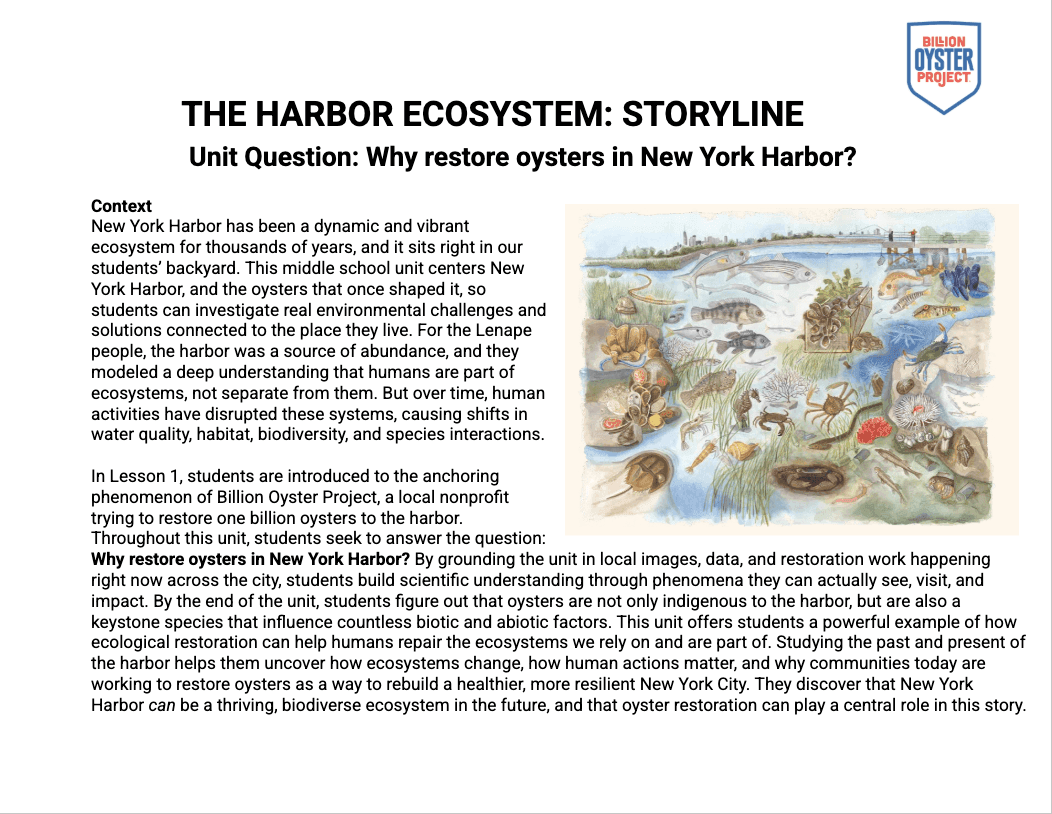
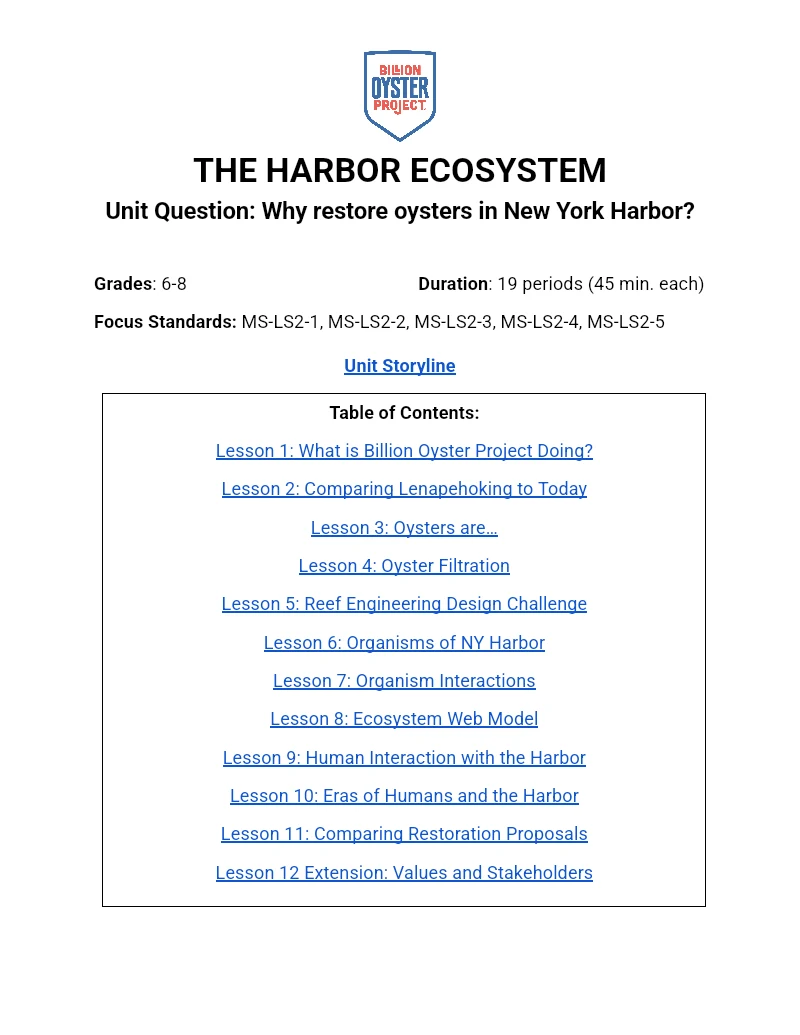
A 12-lesson unit for grades 6-8 anchored on the question: Why restore oysters in New York Harbor? Aligned to NGSS MS-LS2-1 through MS-LS2-5. Approximately 19 class periods (45 min each).

Want to bookmark this unit and track your progress?
Sign up for a free Educator Account

Overview

Core Practices

Sensemaking
Modeling
Engineering Design
Discussion
Source Analysis
Historical Inquiry

What Students Do

Across 12 lessons grounded in the question “Why restore oysters in New York Harbor?”, students figure out what BOP is doing and why. They model the harbor’s food web, design wave-attenuating structures, analyze oyster filtration data, trace 400 years of harbor history through stakeholder lenses, and conclude by comparing two restoration proposals to make a values-informed recommendation.

Pacing & Logistics

Pacing: 19 class periods (45 min each), aligned to MS-LS2-1, MS-LS2-2, MS-LS2-3, MS-LS2-4, and MS-LS2-5.

Logistics: Maintain a Class Question Pool (poster paper or whiteboard section) throughout the unit—students return to it repeatedly. Use the unit’s master Slides deck for all 12 lessons. The Reef Engineering Design Challenge (L5) requires basic engineering supplies; the rest is reading, modeling, and discussion. No field trips.

Field Visits
0
Learning Standards
No standards assigned to this unit, yet.

Materials

LESSONS

4

chapters

CHAPTER
1

New York Harbor Past and Present

Chevron pointing right

Lesson

:

What is Billion Oyster Project Doing?

Document icon with a folded corner and text lines
Stacked presentation slides icon
Length
45 min
Setting
Classroom
Subject
Science
Lesson Question:
What is Billion Oyster Project doing?
Lesson Snapshot

Students look at various images of Billion Oyster Project's oyster restoration work, and make observations and inferences about what BOP is doing in New York Harbor.

Materials & Quick Links

Sign up to access lesson content

Create free teacher credentials to access full lesson plans, downloadable materials, and teaching resources for your classroom.

CHAPTER
1

New York Harbor Past and Present

Chevron pointing right

Lesson

:

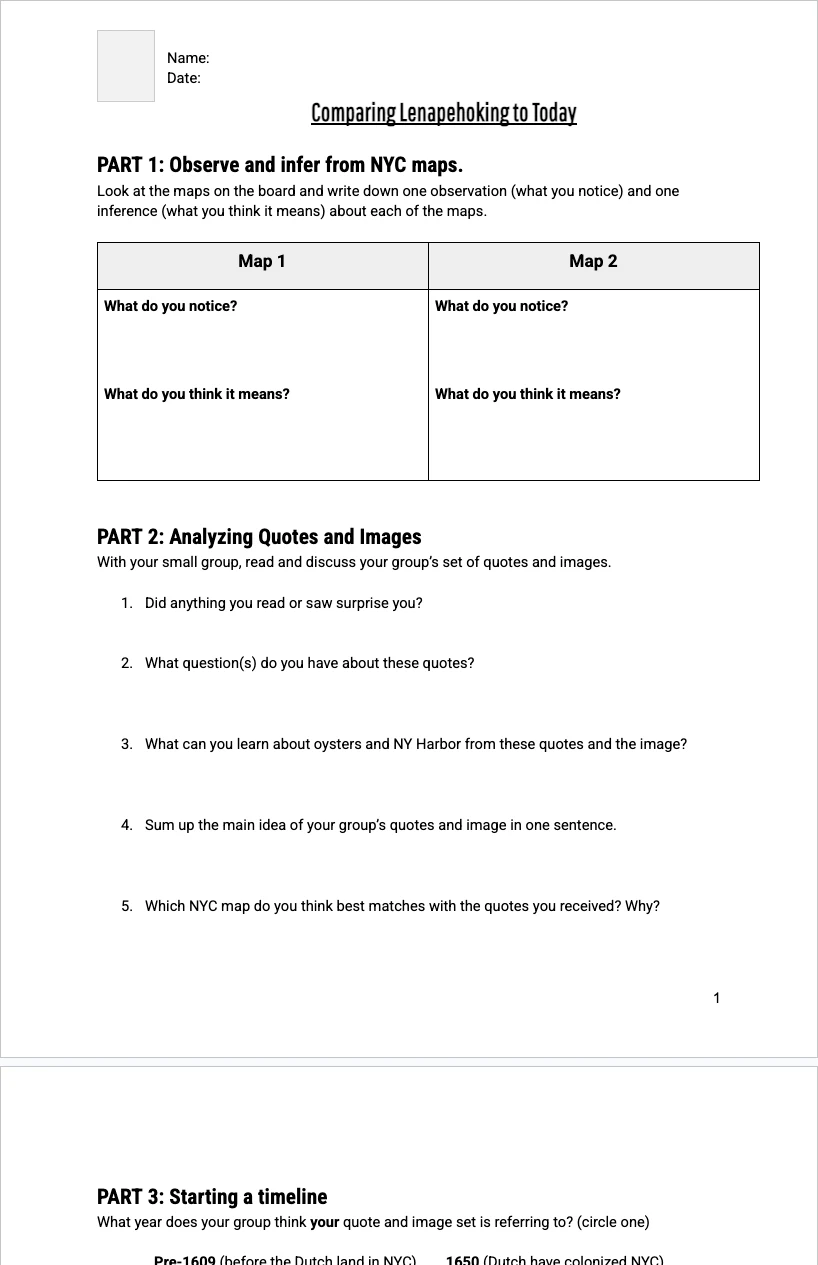
Comparing Lenapehoking to Today

Document icon with a folded corner and text lines
Stacked presentation slides icon
Length
45 min
Setting
Classroom
Subject
Cross-curricular
Lesson Question:
What is New York Harbor like today compared to before European colonists arrived?
Lesson Snapshot

Students observe and analyze maps, quotes, and images about NYC in pre-colonial times and today. They work in small groups to summarize their inferences, and as a class begin to create a timeline of both oyster and human history in NYC.

Materials & Quick Links

Sign up to access lesson content

Create free teacher credentials to access full lesson plans, downloadable materials, and teaching resources for your classroom.

CHAPTER
2

Oysters and their Role in the Harbor Ecosystem

Chevron pointing right

Lesson

:

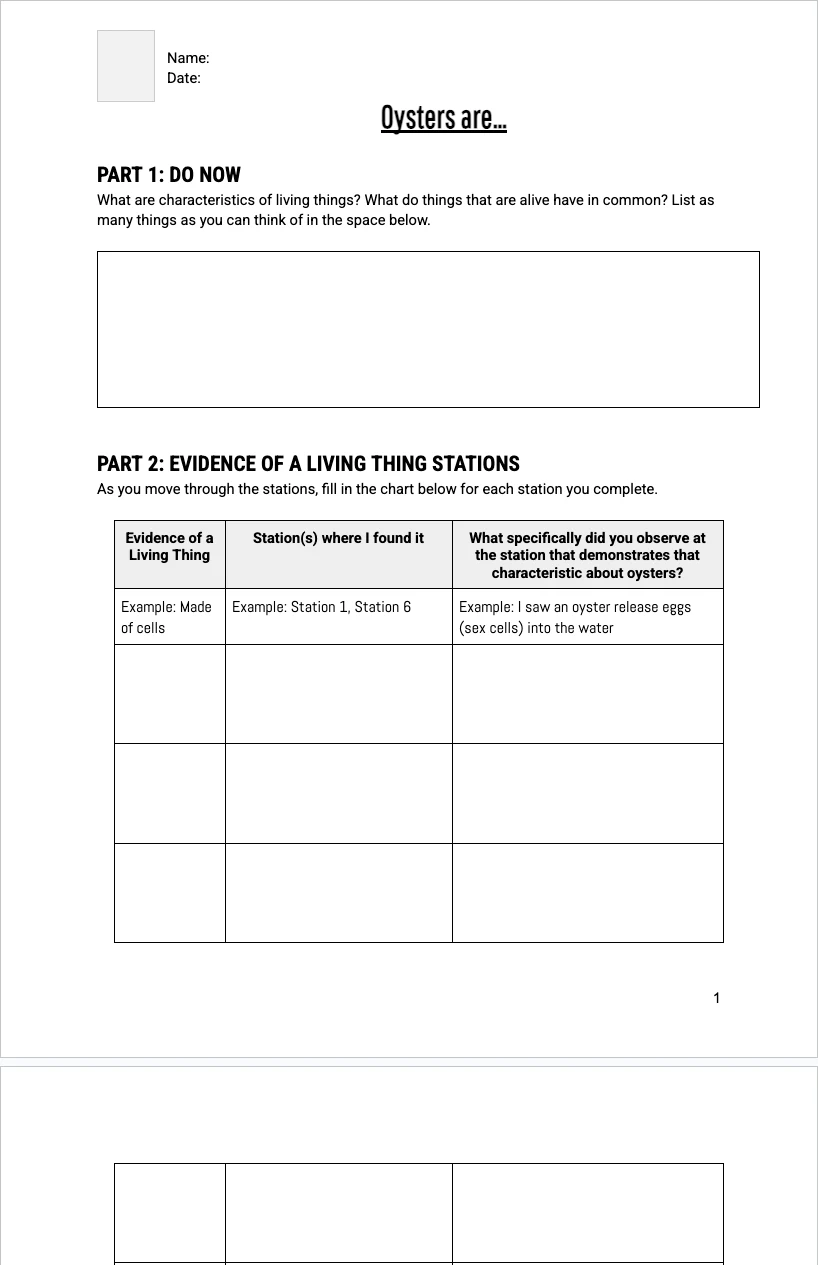
Oysters are…

Document icon with a folded corner and text lines
Stacked presentation slides icon
Length
90 min
Setting
Classroom
Subject
Science
Lesson Question:
What is an oyster?
Lesson Snapshot

Students explore the characteristics of living things through the lens of an oyster. They establish that an oyster is a living thing and an animal by gathering evidence about oysters at seven short stations.

Materials & Quick Links

Sign up to access lesson content

Create free teacher credentials to access full lesson plans, downloadable materials, and teaching resources for your classroom.

CHAPTER
2

Oysters and their Role in the Harbor Ecosystem

Chevron pointing right

Lesson

:

Oyster Filtration

Document icon with a folded corner and text lines
Stacked presentation slides icon
Document icon with a folded corner and text lines
Length
90 min
Setting
Classroom
Subject
Science
Lesson Question:
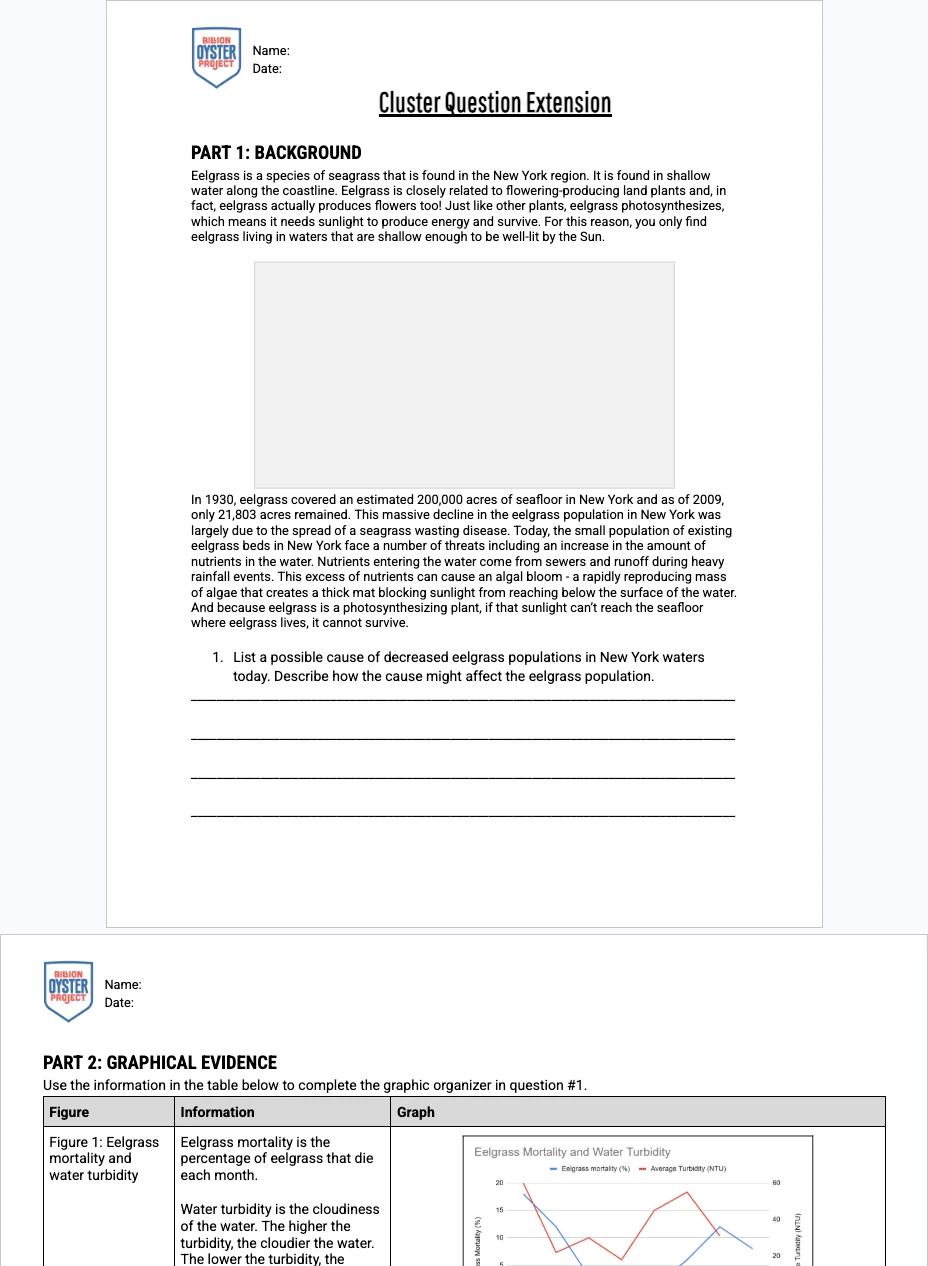
How do oysters filter the water and why is it beneficial?
Lesson Snapshot

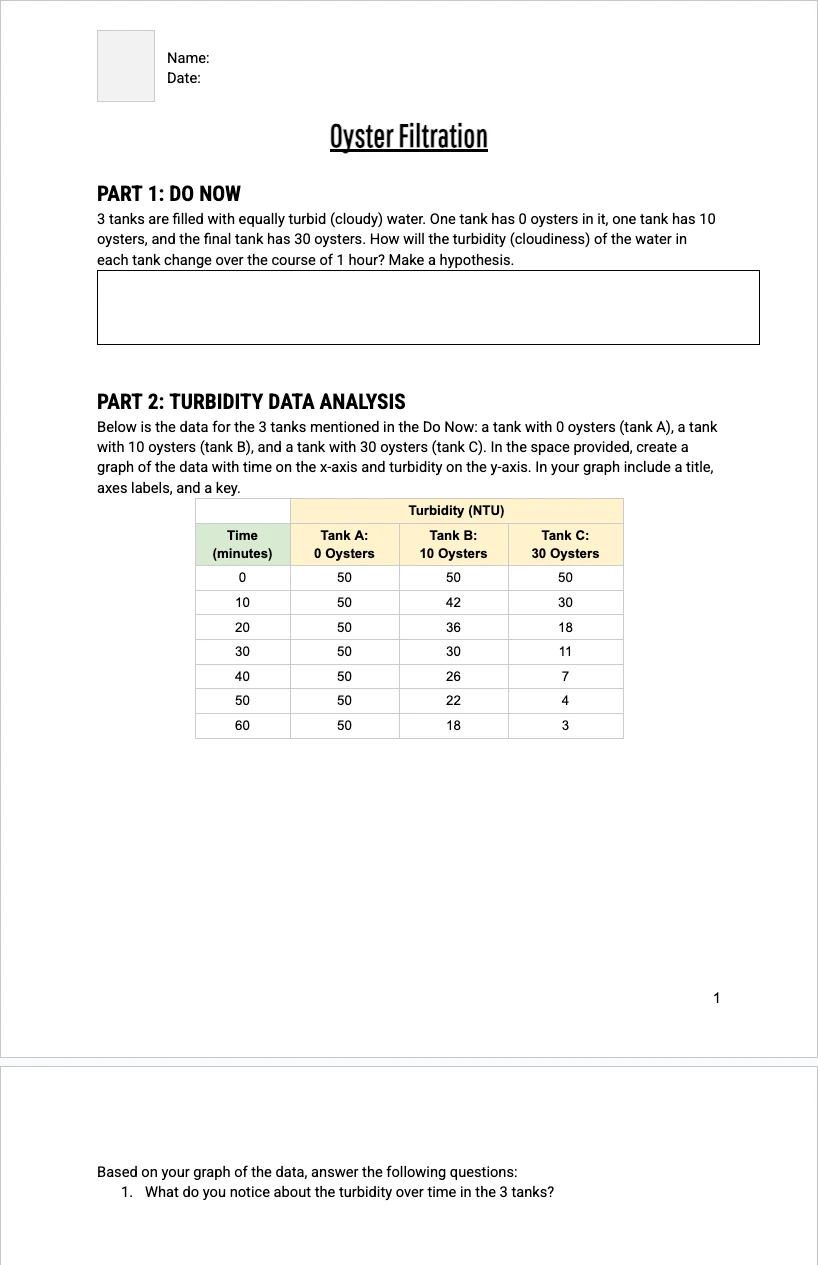
Students use data to analyze how 3 tanks filled with varying amounts of oysters will change over time in terms of their turbidity. They then watch a video explaining the process of filtration by oysters.

Materials & Quick Links

Sign up to access lesson content

Create free teacher credentials to access full lesson plans, downloadable materials, and teaching resources for your classroom.

CHAPTER
2

Oysters and their Role in the Harbor Ecosystem

Chevron pointing right

Lesson

:

Reef Engineering Design Challenge

Document icon with a folded corner and text lines
Stacked presentation slides icon
Document icon with a folded corner and text lines
Length
90 min
Setting
Classroom
Subject
Science
Lesson Question:
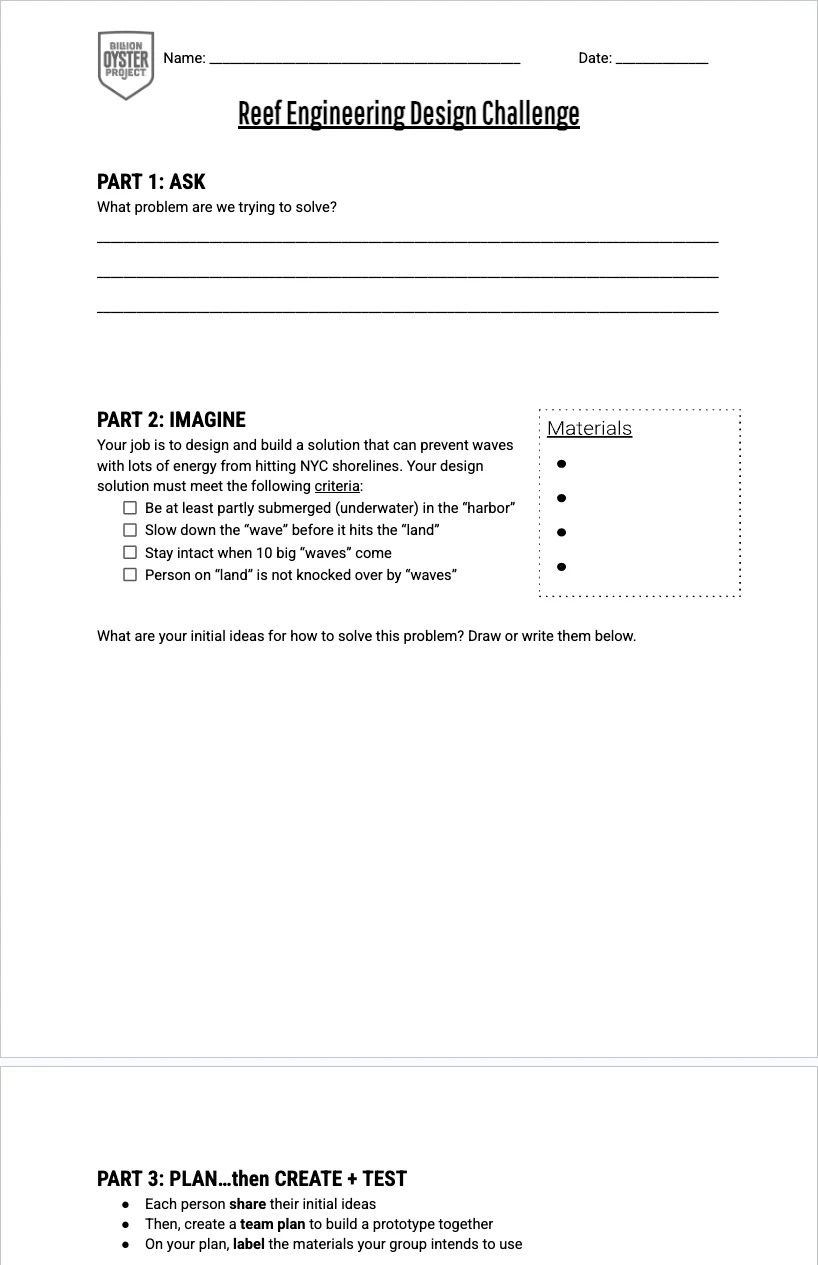
How does the physical structure of oyster reefs impact waves that crash into them?
Lesson Snapshot

In this hands-on lesson, students design and build a structure that can break wave energy before it hits land. They collaborate through the engineering design process and identify wave attenuation as another ecosystem function that oysters provide.

Materials & Quick Links

Sign up to access lesson content

Create free teacher credentials to access full lesson plans, downloadable materials, and teaching resources for your classroom.

CHAPTER
2

Oysters and their Role in the Harbor Ecosystem

Chevron pointing right

Lesson

:

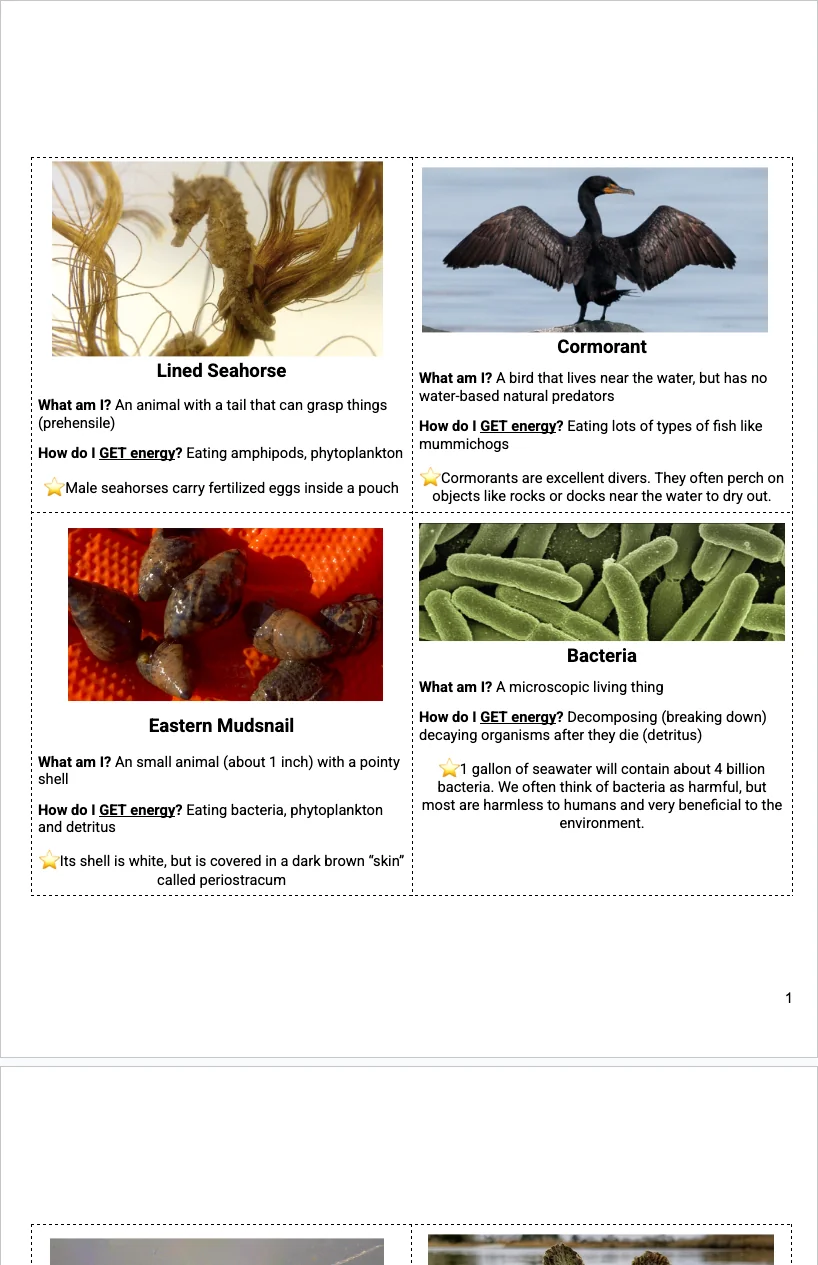
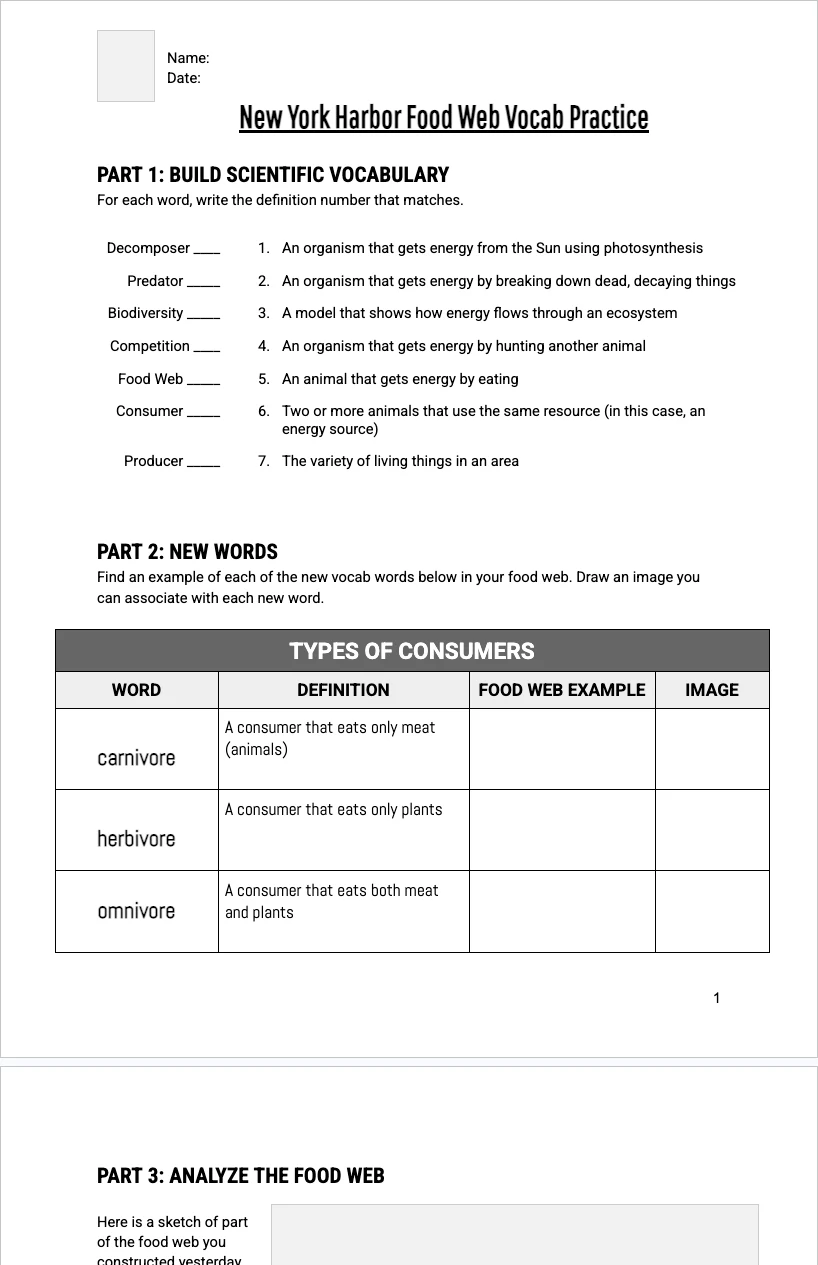
Organisms of NY Harbor

Document icon with a folded corner and text lines
Stacked presentation slides icon
Document icon with a folded corner and text lines
Length
90 min
Setting
Classroom
Subject
Science
Lesson Question:
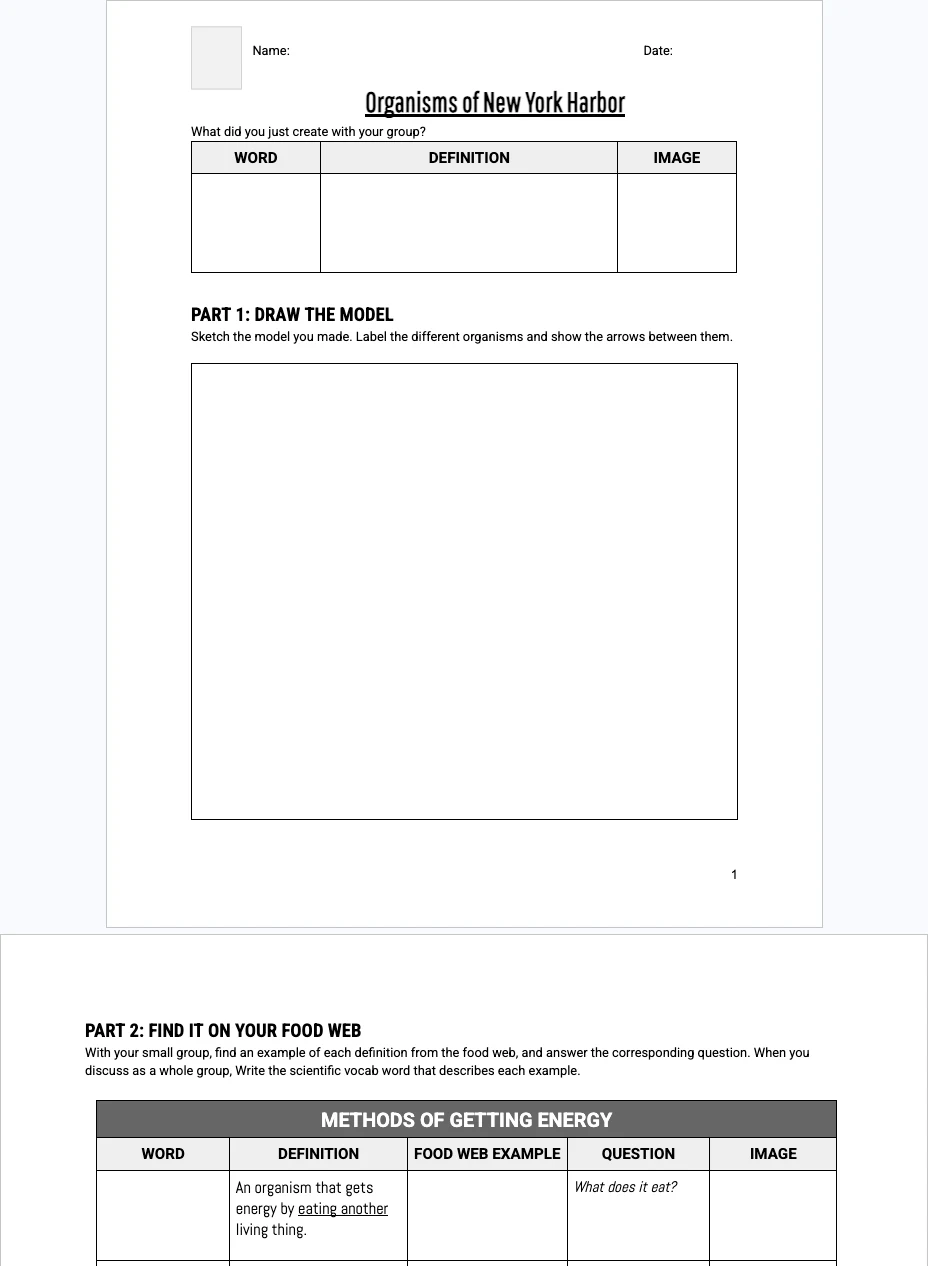
Where do all the living things in NY Harbor get energy?
Lesson Snapshot

In this hands-on lesson, students use information cards about organisms in New York Harbor to create a model of the food web. They identify patterns in the interactions and learn new vocabulary to name those interaction types.

Materials & Quick Links

Sign up to access lesson content

Create free teacher credentials to access full lesson plans, downloadable materials, and teaching resources for your classroom.

CHAPTER
2

Oysters and their Role in the Harbor Ecosystem

Chevron pointing right

Lesson

:

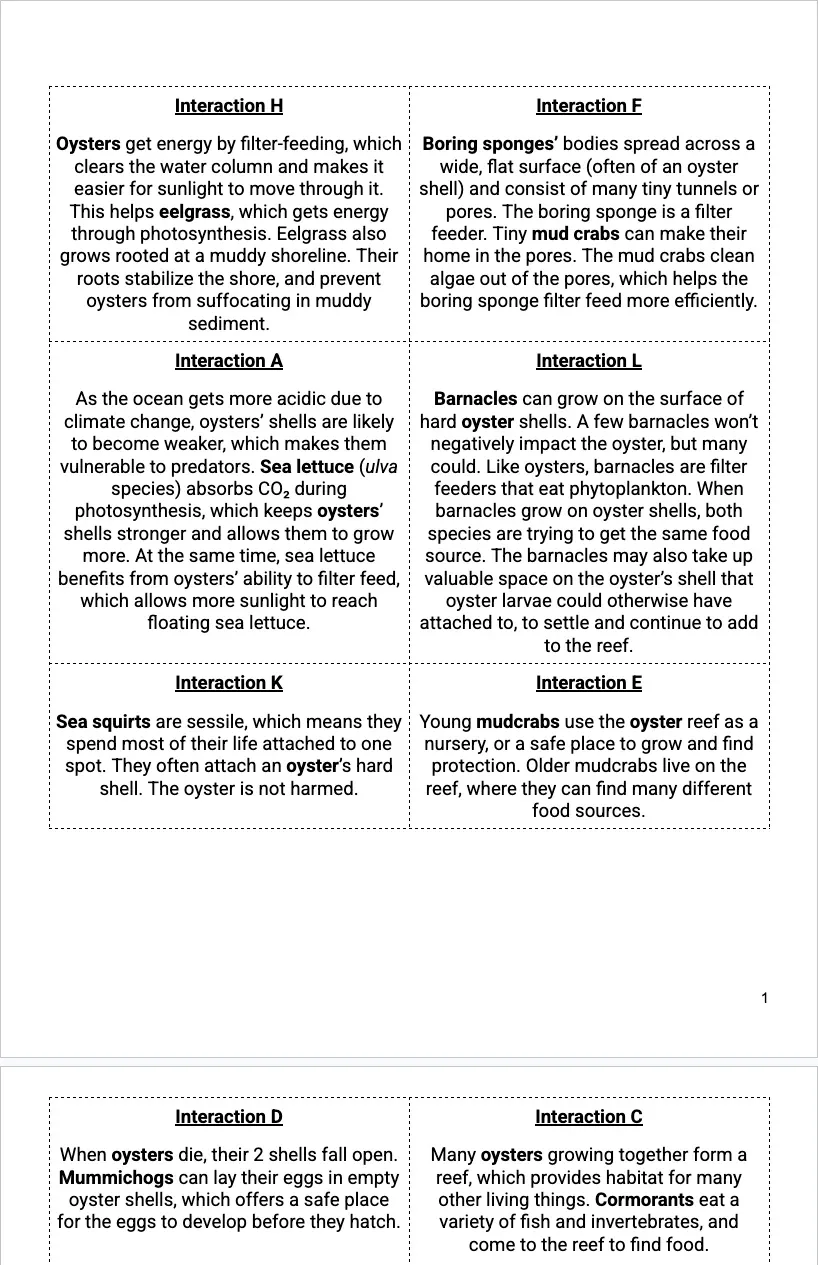
Organism Interactions

Document icon with a folded corner and text lines
Stacked presentation slides icon
Document icon with a folded corner and text lines
Length
45 min
Setting
Classroom
Subject
Science
Lesson Question:
How else do organisms in New York Harbor interact, besides just energy transfer as part of the food web?
Lesson Snapshot

Students sort cards describing different interactions between organisms in New York Harbor. They identify shared characteristics of each interaction type and learn key vocabulary to label each interaction — many of which involve oysters.

Materials & Quick Links

Sign up to access lesson content

Create free teacher credentials to access full lesson plans, downloadable materials, and teaching resources for your classroom.

CHAPTER
2

Oysters and their Role in the Harbor Ecosystem

Chevron pointing right

Lesson

:

Ecosystem Web Model

Document icon with a folded corner and text lines
Stacked presentation slides icon
Document icon with a folded corner and text lines
Length
45 min
Setting
Classroom
Subject
Science
Lesson Question:
Why is Billion Oyster Project trying to restore oysters to NY Harbor?
Lesson Snapshot

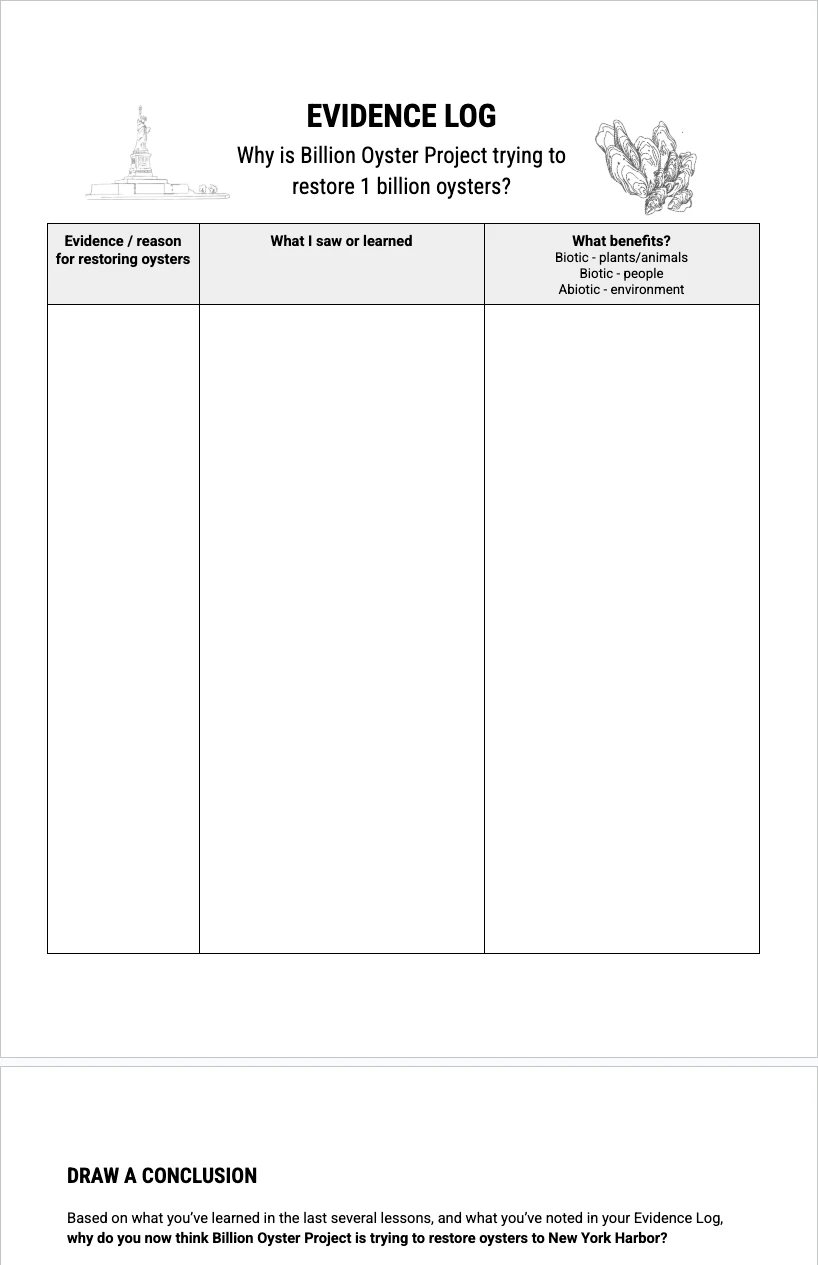
Students add information about different types of interactions between organisms (mutualism, parasitism, commensalism) to their food web to create an Ecosystem Web Model. They use their model and Evidence Log to write an argument explaining why BOP is restoring oysters.

Materials & Quick Links

Sign up to access lesson content

Create free teacher credentials to access full lesson plans, downloadable materials, and teaching resources for your classroom.

CHAPTER
3

Human Impact on the New York Harbor Ecosystem

Chevron pointing right

Lesson

:

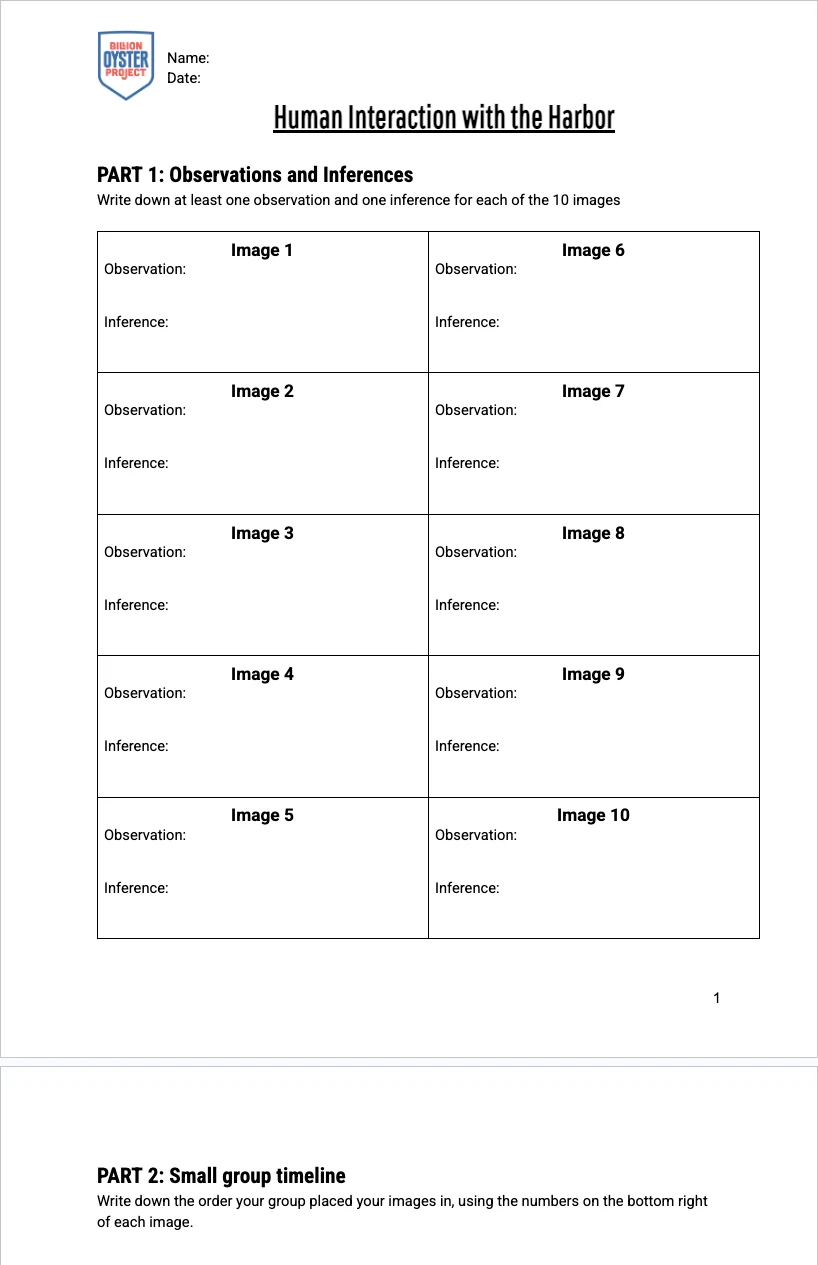
Human Interaction with the Harbor

Document icon with a folded corner and text lines
Stacked presentation slides icon
Document icon with a folded corner and text lines
Length
90 min
Setting
Classroom
Subject
Social Studies
Lesson Question:
How have people interacted with the harbor over time?
Lesson Snapshot

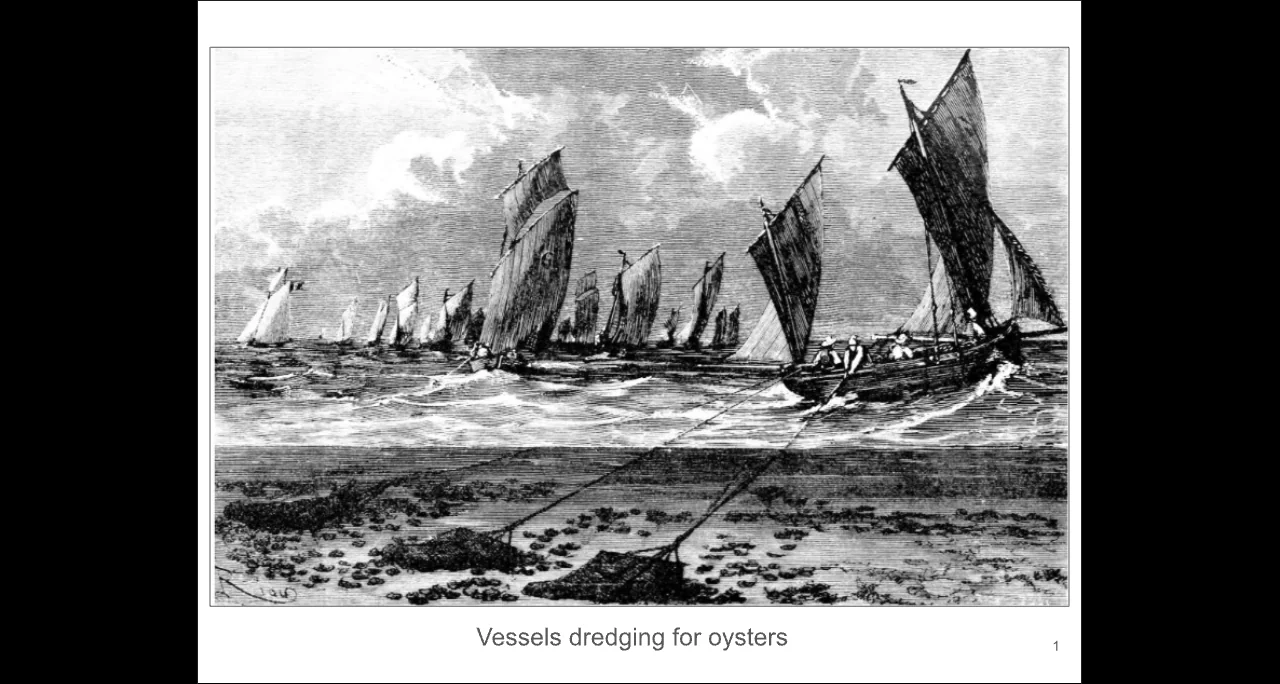
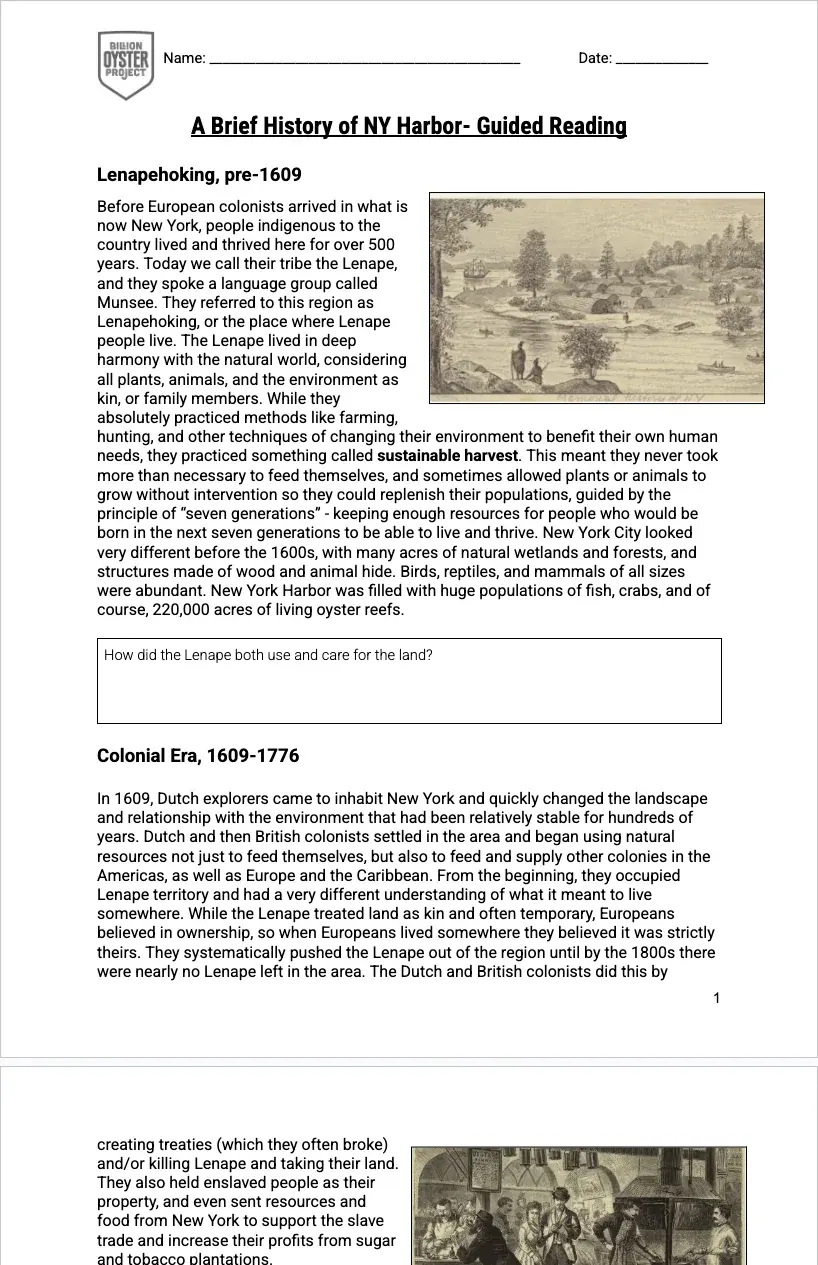
Students use images spanning the last 400 years of NY Harbor history to make observations and inferences, then put them in order to create a timeline. They read a brief history of the harbor to reassess their timeline choices.

Materials & Quick Links

Sign up to access lesson content

Create free teacher credentials to access full lesson plans, downloadable materials, and teaching resources for your classroom.

CHAPTER
3

Human Impact on the New York Harbor Ecosystem

Chevron pointing right

Lesson

:

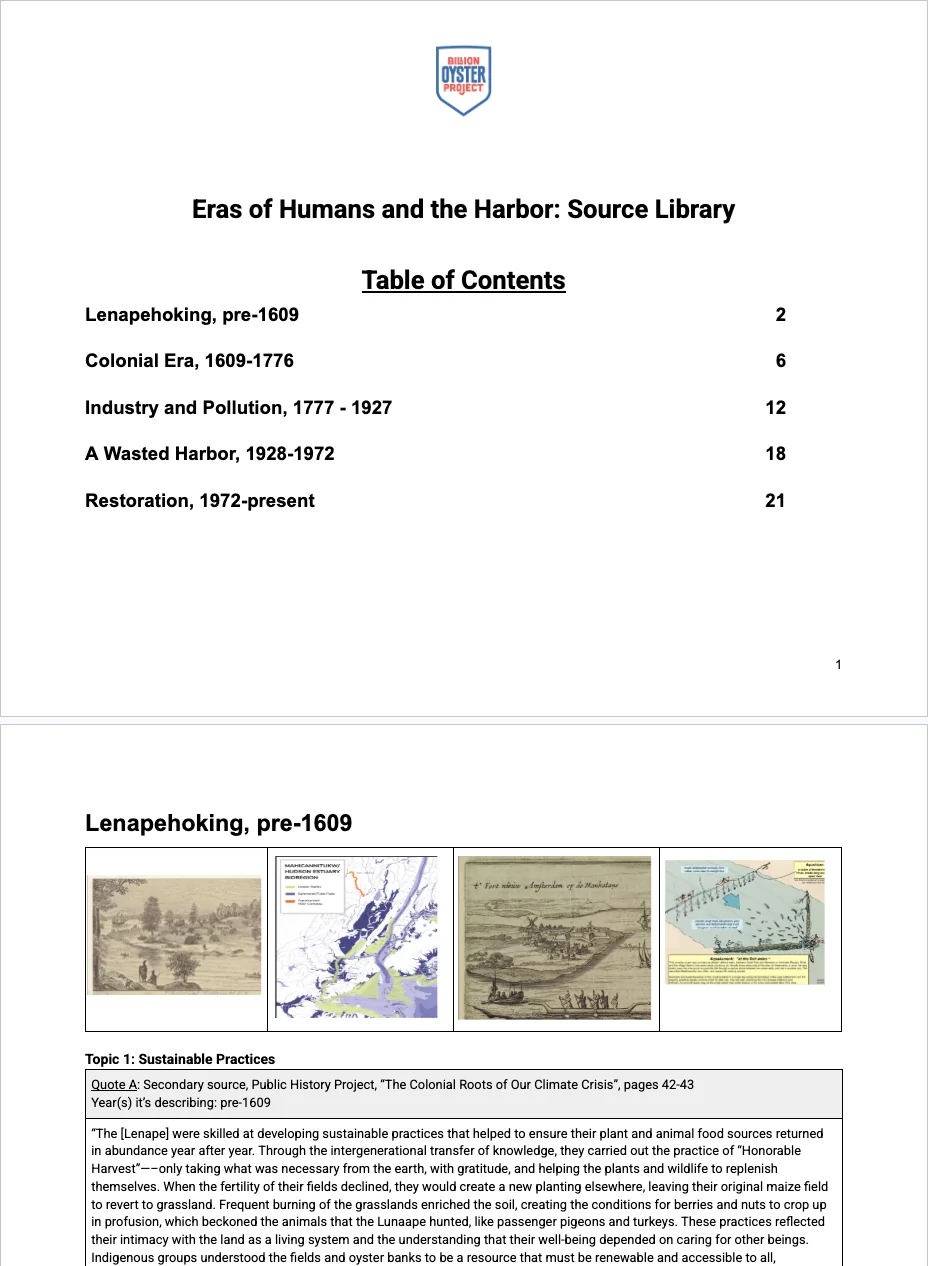
Eras of Humans and the Harbor

Document icon with a folded corner and text lines
Stacked presentation slides icon
Document icon with a folded corner and text lines
Length
90 min
Setting
Classroom
Subject
Social Studies
Lesson Question:
Over time, have humans impacted the harbor positively, negatively, or both?
Lesson Snapshot

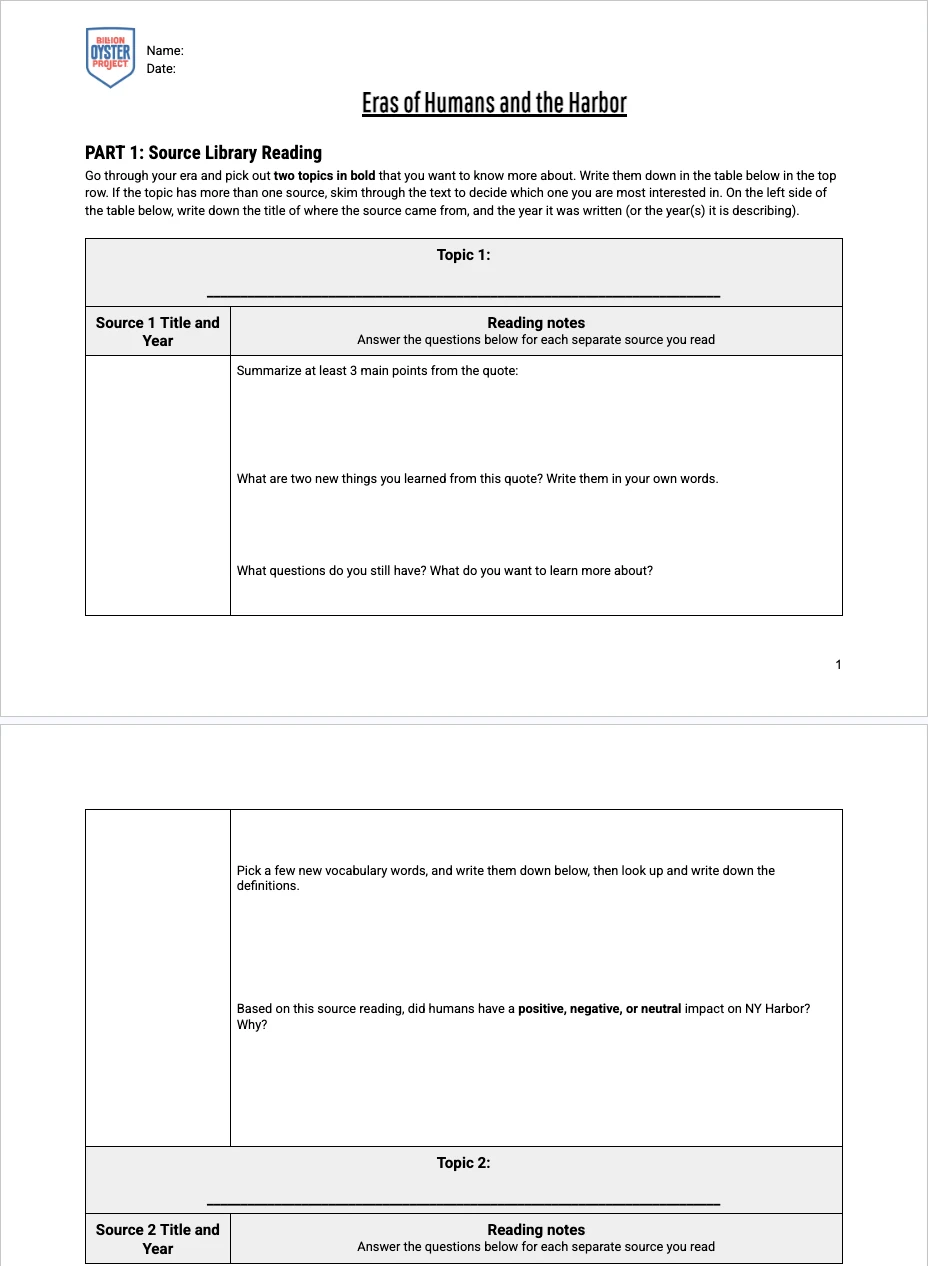
Based on the images that draw their interest, students dive deep into particular eras of human history on New York Harbor using a Source Library. They make a claim about whether humans had a positive, negative, or neutral impact on the Harbor during a single era, and over time.

Materials & Quick Links

Sign up to access lesson content

Create free teacher credentials to access full lesson plans, downloadable materials, and teaching resources for your classroom.

CHAPTER
4

Restoring the Harbor Ecosystem

Chevron pointing right

Lesson

:

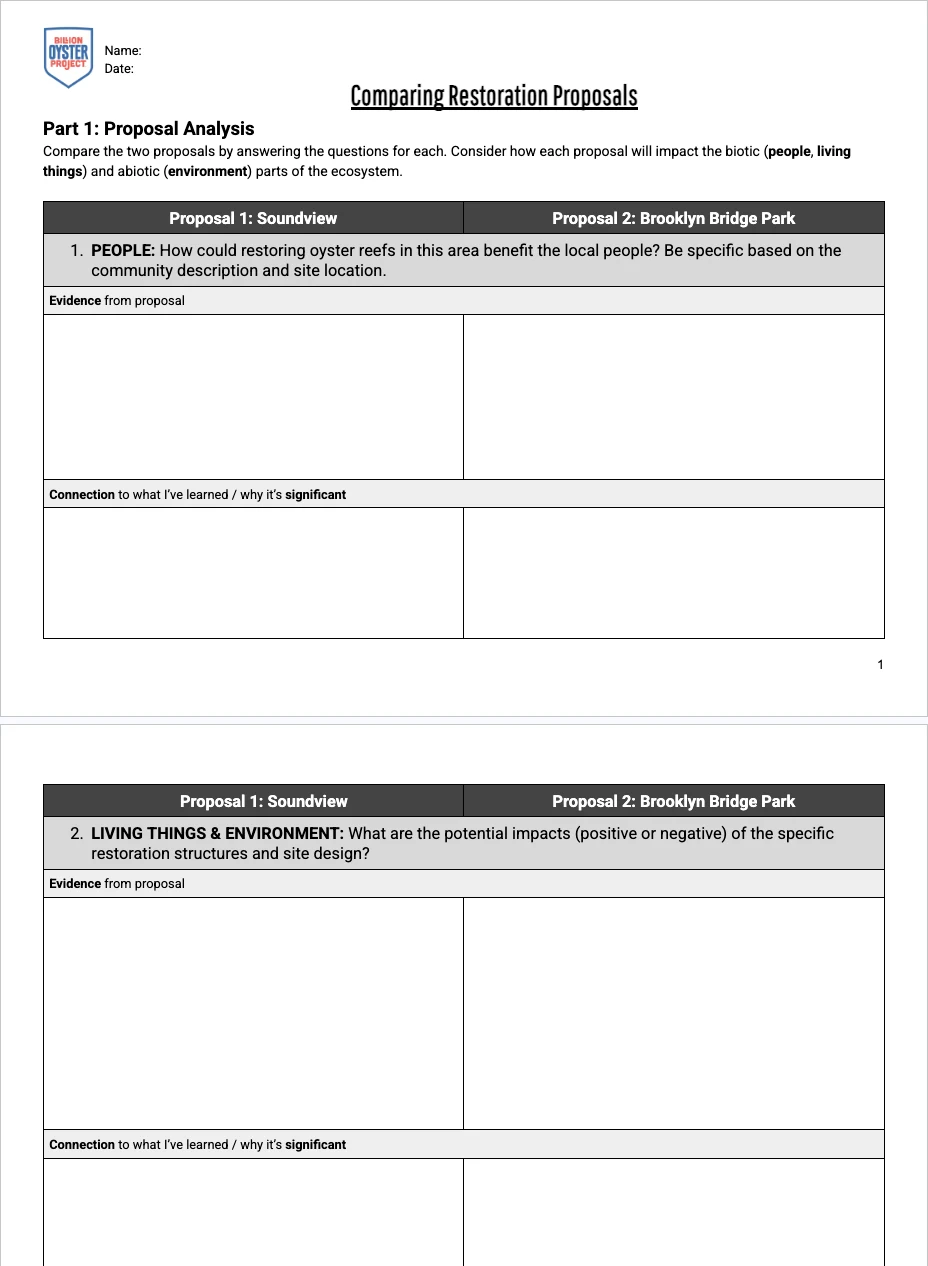
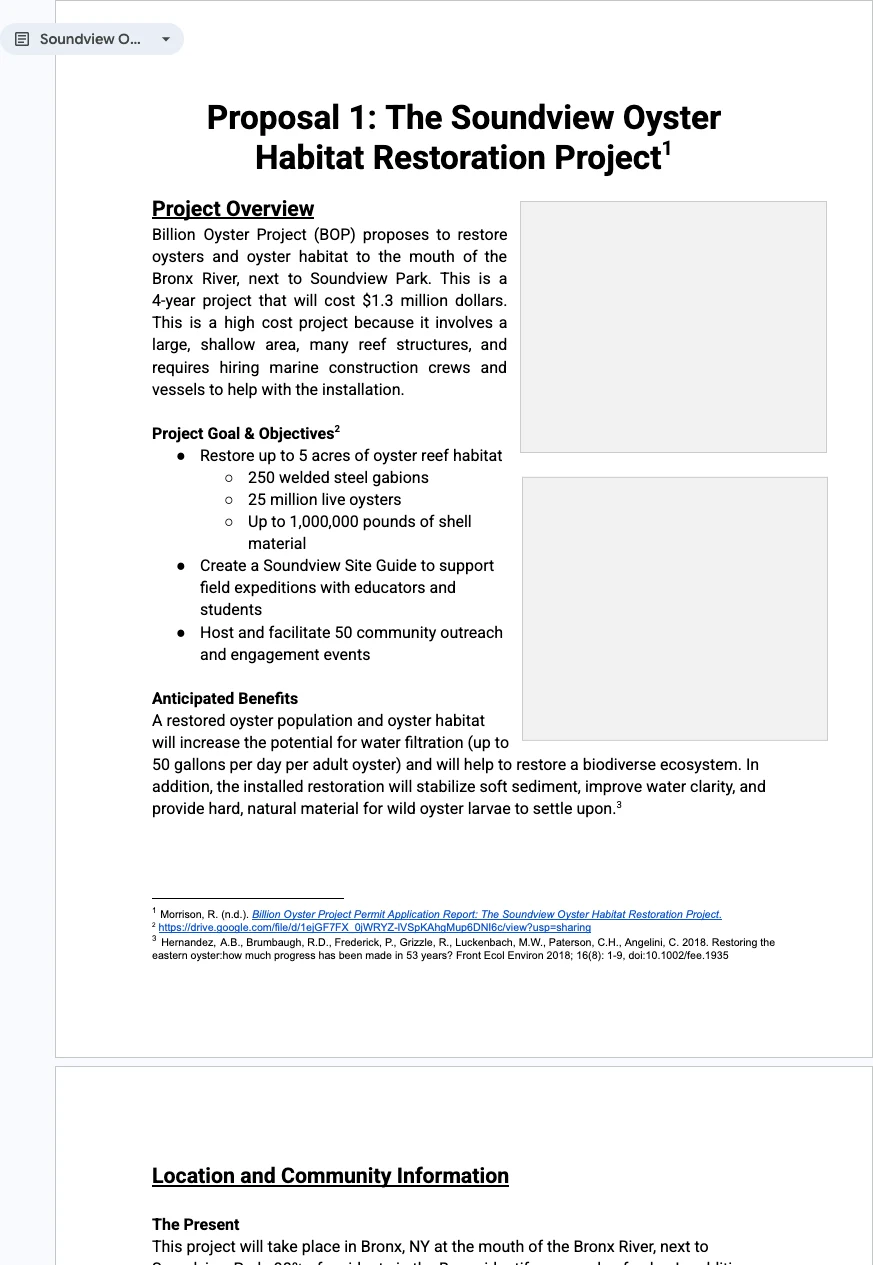
Comparing Restoration Proposals

Document icon with a folded corner and text lines
Stacked presentation slides icon
Document icon with a folded corner and text lines
Length
135+ min
Setting
Classroom
Subject
Science
Lesson Question:
Which restoration proposal provides the greatest positive impact on the NY Harbor ecosystem?
Lesson Snapshot

Students read, evaluate, and thoroughly discuss two restoration proposals. They work together to decide which proposal provides the greatest positive impact on the greater NY Harbor ecosystem, and advocate for their decision by preparing a project about their chosen proposal.

Materials & Quick Links

Sign up to access lesson content

Create free teacher credentials to access full lesson plans, downloadable materials, and teaching resources for your classroom.

CHAPTER
4

Restoring the Harbor Ecosystem

Chevron pointing right

Lesson

:

Values & Stakeholder Analysis

Document icon with a folded corner and text lines
Stacked presentation slides icon
Document icon with a folded corner and text lines
Length
45 min
Setting
Classroom
Subject
Cross-curricular
Lesson Question:
What are your personal values related to the ecosystem?
Lesson Snapshot

Students complete a values reflection to identify their own beliefs and perspectives about ecosystems and New York Harbor. After reading profiles of several stakeholders in BOP's restoration efforts, they reflect on the impact differing values can have on the restoration process.

Materials & Quick Links

Sign up to access lesson content

Create free teacher credentials to access full lesson plans, downloadable materials, and teaching resources for your classroom.