Don't forget to complete your donation
complete your donation

we're looking toward the future

Photo: One million oysters in a jar.

For decades, New York Harbor was written off as too polluted and too far gone to fix.

We never accepted that. We were built on the idea that restoration would require new ways of working and thinking in a city defined by its advancements in innovation and technology. 

Aerial view of Lower Manhattan and New York Harbor on an overcast day
Worker in a life vest examines a small sample container aboard a restoration barge

Modern-Day Innovators of New York Harbor

We are rebuilding the foundation of the estuarine ecosystem and advocating for access to the New York Harbor. That means designing reefs that can function in a thriving urban estuary and generating the data needed to guide it forward.

Innovation as Infrastructure

Innovation allows us to grow from restoring millions of oysters to hundreds of millions of oysters per year. It’s the monitoring methods and technologies that show us what’s working and what’s not. We are designing a model other cities can follow.

Crew hoists two concrete reef structures above a barge during deployment preparations

innovating is the key to scale

How we're getting to one billion oysters by 2030.

Restoring one billion oysters by 2030 requires understanding how New York Harbor functions as a connected ecosystem and building the science, infrastructure, and long-term planning needed to restore it at scale. When we started, many questioned whether oyster restoration was even possible. Today, we know oysters can survive and reproduce throughout the Harbor.

Our focus has shifted from individual restoration sites to a harbor-wide strategy designed around reef connectivity, adaptive management, and long-term ecosystem recovery. Working alongside leading scientific and restoration partners, we are developing the data and tools needed to guide where reefs are built, how they interact, and what it will take to create a self-sustaining Harbor for future generations.

Sincerely,
Handwritten signature
Carolyn Khoury
Director of Restoration
upcoming
expeditions
upcoming
01

Harbor Modeling & Reef Connectivity

Working with Cornell University and Norwich University to better understand larval behavior, hydrodynamics, and reef connectivity throughout the Harbor.
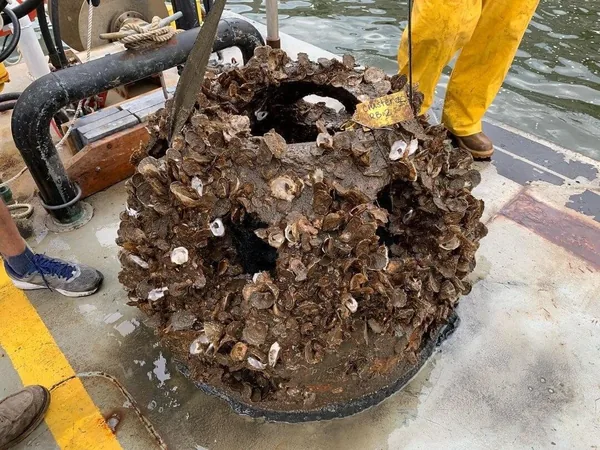
Reef ball densely covered with live oysters hauled onto a boat deck
Model how water movement and oyster larval behavior influence where oyster larvae travel, disperse, and settle across the Harbor.
Identify the network of restoration sites that are most likely to support long-term reef persistence, recruitment, and connectivity between oyster populations.
Support science-based harbor-wide restoration planning by integrating hydrodynamic modeling and genomic analysis to better understand how restored reefs function as an interconnected estuary-wide network.  
Develop publishable scientific models and tools that can help inform oyster restoration and estuary management efforts beyond New York Harbor.
02

Habitat Evaluation & Site Selection  

Working with Natrx to develop a science-based habitat evaluation and site prioritization framework for oyster restoration. Using existing spatial datasets of the natural and built environment, we are evaluating biophysical conditions such as depth, salinity, dissolved oxygen, shoreline erosion, wave exposure, and surrounding built infrastructure to help identify and compare potential restoration sites across the Harbor.
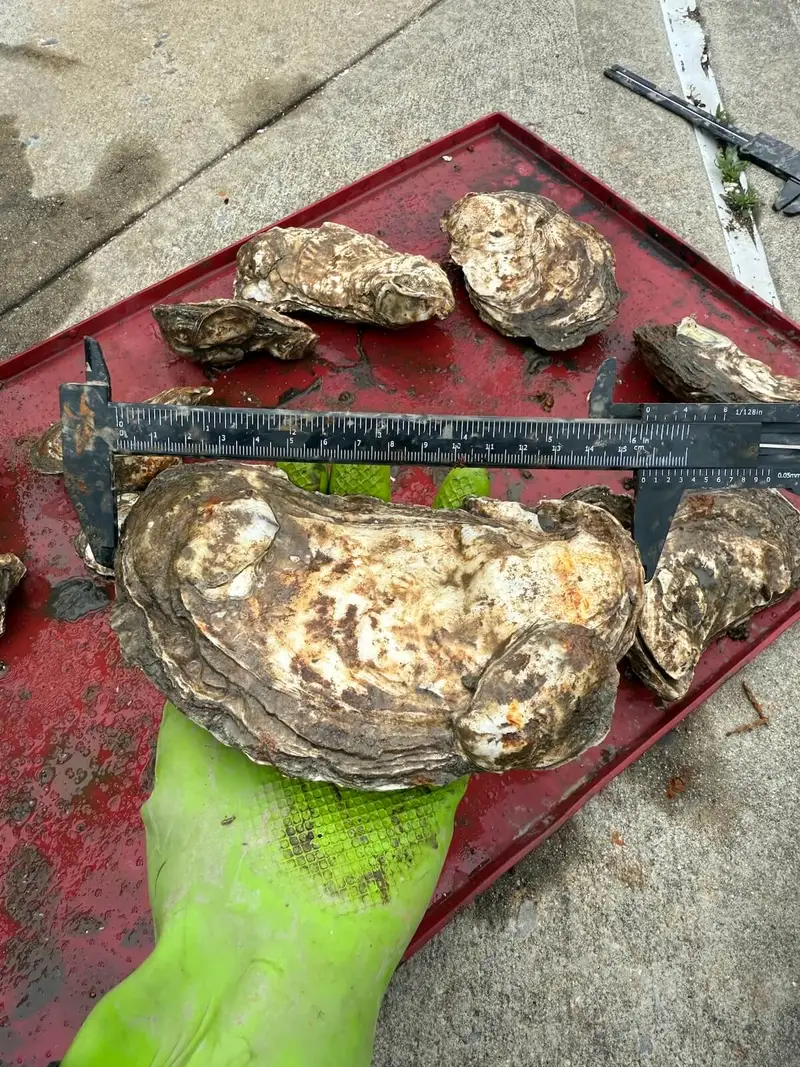
Gloved hand measuring a large oyster with calipers during habitat monitoring
Identify and prioritize sites with environmental conditions most likely to support long-term oyster reef success and resilience.
Evaluate restoration opportunities alongside practical considerations such as constructability, shoreline stabilization potential, nearby infrastructure, and permitting constraints.
Develop a science-based, transparent framework to guide future field investigations, reef design, and long-term restoration planning across the Harbor.
03

Reconstructing Oyster History 

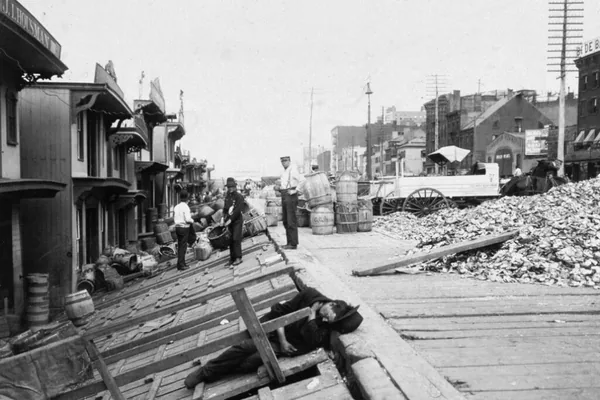
Restoration also requires understanding what existed before industrialization reshaped the Harbor. We are supporting core sampling of historic reefs to study oyster reefs and buried estuarine layers beneath New York Harbor.
Historical photo of oyster barges and shell piles along the New York waterfront
Researchers are exploring areas near Ellis Island and the Statue of Liberty to recover pieces of the historic seafloor.
This research helps establish a clearer understanding of the ecological conditions that once supported large-scale oyster populations and informs how oyster restoration projects are designed today.
This work that has rarely been attempted in the Harbor.
04

Monitoring & Biodiversity Tracking

Innovation is also changing how restoration is monitored in real time. These efforts help build a more complete understanding of how biodiversity responds as reefs return.
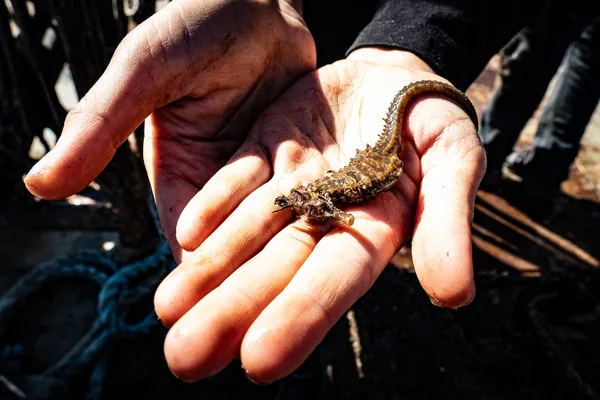
Seahorse resting in an open palm, found among gear pulled from New York Harbor
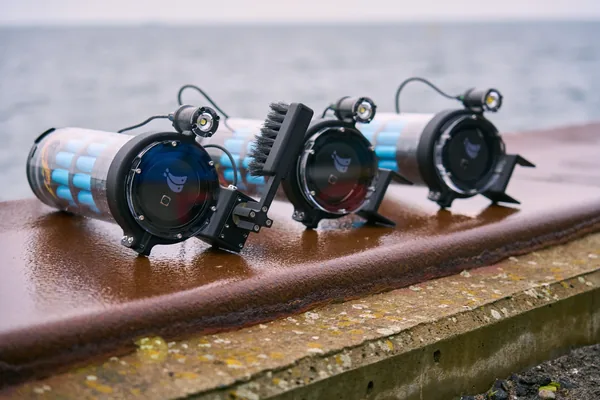
Underwater camera systems with Anemo Robotics to document fish presence, abundance, and habitat use patterns on restored reefs and reference sites across time.
AI-assisted video review to process and analyze large volumes of underwater video more efficiently and consistently.
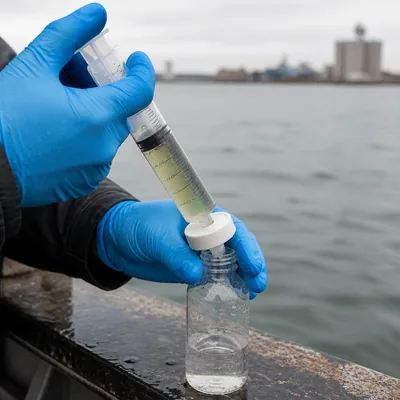
eDNA sampling to expand how biodiversity and species presences are measured across the Harbor.
05

Infrastructure & Restoration Technology

We are introducing our Remote Setting Barge in 2027. Designed specifically for large-scale oyster restoration, the barge will allow our team to set oyster larvae directly onto shell and reef structures while on the water before installing them across the Harbor.
Infrastructure dramatically increases restoration capacity while maintaining high spat survival rates during the installation period.
One of the key systems helping move restoration from roughly 15 million oysters annually toward 100+ million oysters per year.
Aerial concept rendering of a Billion Oyster Project reef barge loading concrete reef structures at a pier
Concept design by Billion Oyster Project / Persak & Wurmfeld
Aerial concept rendering of a Billion Oyster Project reef barge deploying reef structures near a shoreline
Concept design by Billion Oyster Project / Persak & Wurmfeld
Concept rendering of a Billion Oyster Project reef barge being towed past a harbor bridge
Concept design by Billion Oyster Project / Persak & Wurmfeld

Upcoming Expeditions

In 2026, we will launch a series of expeditions exploring the past, present, and future of New York Harbor.
Oyster larvae seen through a microscope with a measuring scale
Larval transport modeling and reef connectivity
Expeditions to show how oyster larval behavior and estuarine hydrodynamics interact to connect potential restoration sites to one another.
Three cylindrical underwater monitoring cameras with lights lined up on a ledge by the harbor
Anemo Robotics
Expeditions to deploy underwater cameras and monitoring systems to document species and use patterns associated with restored reef sites.
Learn more
Greater yellowlegs standing in shallow water
American Bird Conservancy and New York Bird Alliance
Expeditions to monitor bird data so we can understand activity above the water. Currently, ABC has monitored over 130 bird species using the Harbor.
Learn more
Gloved hands filter a harbor water sample for environmental DNA analysis
eDNA SAMPLING
Expeditions to explore how we measure biodiversity across the Harbor. We have documented over 50 species on our restoration sites.
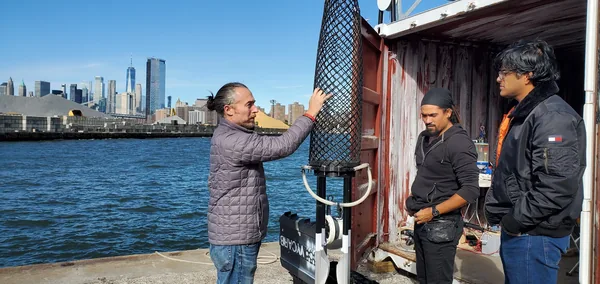
Researchers examining a Vycarb water chemistry unit on a pier with the Manhattan skyline behind
Vycarb
Expeditions to evaluate how oyster restoration may contribute to carbon removal in emerging markets, focused on climate mitigation in New York Harbor.
Learn more
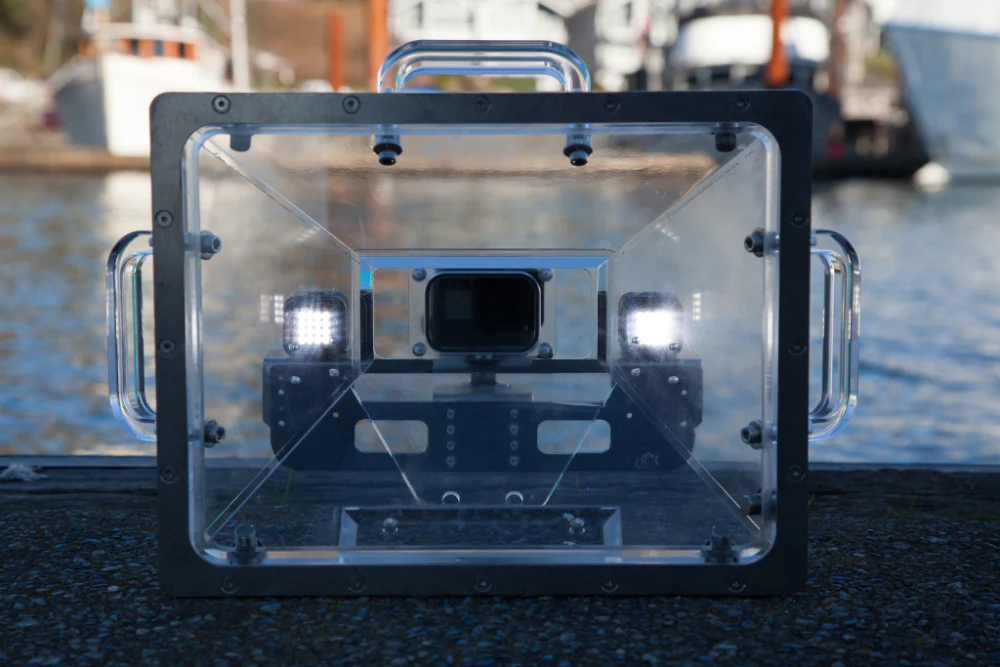
Underwater camera in a clear waterproof housing on a dock
Clearwater Box
Capturing underwater footage and facilitate field observations and data collection, providing more opportunities for non-destructive sampling post-restoration.
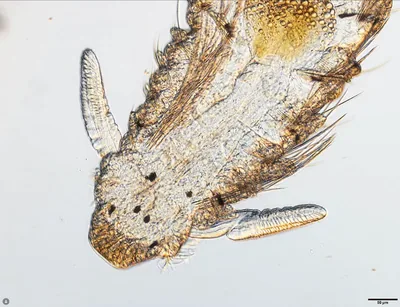
Microscopic plankton organism from harbor water magnified under a microscope
Phytoplankton Study
Alongside National Geographic Explorer, Gabrielle Corradino, we'll analyze Hudson River plankton communities to reveal the nutritional value of oyster food sources, giving us its first-ever window into oyster diet at restoration sites.
Learn more
Golden reeds and salt marsh grasses at Four Sparrow Marsh under an overcast sky
Four Sparrow Marsh Site Investigation
A first-time expedition to Four Sparrows, one of the sites that could be strong contender for oyster restoration alongside Protect our Winters.