
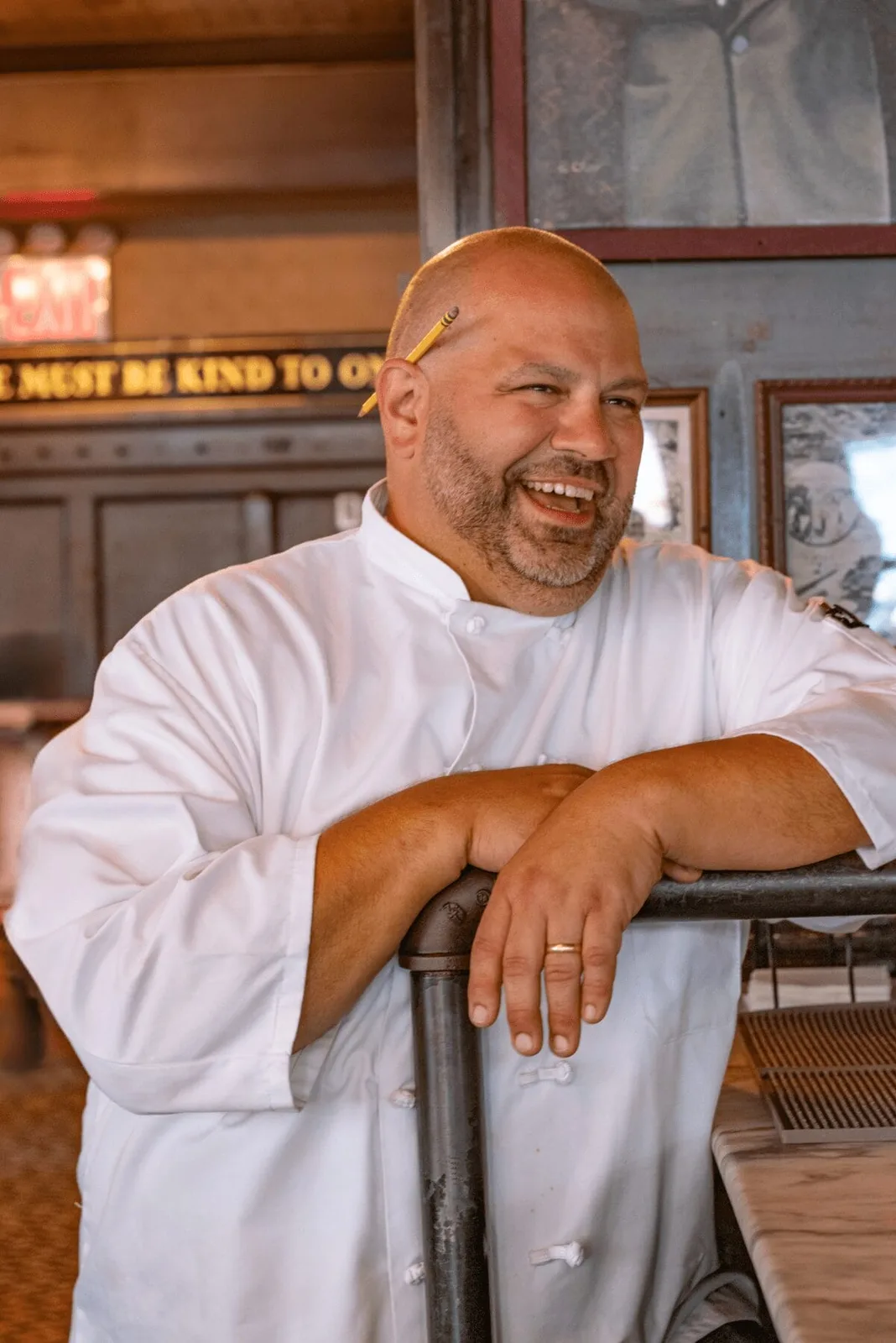
If you spend enough time at the raw bar at P.J. Clarke’s, eventually you’ll hear a story. Maybe it’s about old New York. Maybe it’s about the harbor before the skyline. Maybe it’s about oysters themselves. Where they came from, how they built this magnificent city, and why they still matter today. More often than not, the person telling that story is Executive Chef Michael Defonzo.
Chef Mike has spent nearly three decades at P.J. Clarke’s, but his relationship with food started much earlier. Growing up between New Jersey and Long Island, he was the kind of kid who disappeared into the kitchen before anyone asked him to. By seven years old, he was already trying to barbecue on his own; once accidentally lighting his hair on fire in the process. Back then, he thought he might become a history teacher. Instead, he became a chef who treats food like history on a plate served up just for you.
That perspective runs through everything he does at P.J. Clarke’s. For Mike, cooking means to understand where ingredients come from, the people connected to them, and the stories they carry. Oysters, especially, hold a particular fascination for him. Inspired by The Big Oyster by Mark Kurlansky, Chef Mike became deeply interested in the role oysters once played in New York Harbor. Yes, of course, as food. But just as much as infrastructure that helped make New York what it is today. An economic and cultural powerhouse, all thanks to oysters, which were once found in the trillions along these shorelines.
You can feel that connection standing at the raw bar with him. Oysters arrive piled onto crushed ice, tagged by region and tasting notes. Think briny Blue Points, buttery Island Creeks, crisp Wellfleets—some of the classics. Chef Mike shucks while talking to guests across the counter, moving easily between stories about oyster varietals, harbor history, and whatever unpredictable energy the night happens to bring. That interaction is part of what he loves most about working the raw bar. There’s a constant motion to it. Conversation that could never end. A kind of organized chaos that feels deeply true to our home, New York.
And P.J. Clarke’s is one of the last places where that old New York oyster culture still feels fully intact. At the original 3rd Avenue location, the room still hums with the energy of a city that refuses to slow down. Chef Mike often talks about the feeling there during the holidays. The smell coming from the kitchen, the packed bar, the glow spilling onto the street outside. “Electric” is the word he uses. It’s the kind of atmosphere that can’t really be replicated. It has to build and compound over decades.
That same spirit now stretches across all P.J. Clarke’s locations, from Lincoln Square to On The Hudson to Manhattan West, the newest addition to the family. And while each location has its own way of working, oysters remain central to all of them.
For Chef Mike, that connection to oysters, and to us at Billion Oyster Project, is foundational. The oysters served at the raw bar are tied directly back to the waters surrounding the city. The shells, after dinner, return to the harbor as recycled materials. They help rebuild habitat, support biodiversity, and contribute to the future of the estuary that once made New York one of the oyster capitals of the world. Diners’ used oyster shells create new oyster reefs all around the city and are why we have 183 million oysters in the water today!
It’s a full-circle story that makes perfect sense at P.J. Clarke’s—a restaurant where history is celebrated. Here, oysters still bring people together. And where Chef Mike continues to remind guests that food is always about more than what’s on the plate.
Want to eat with Chef Mike? Book a reservation now!
